The training was attended by leaders and experts from state management agencies under the Ministry of Agriculture and Environment, including the Department of International Cooperation, the Department of Forestry and Forest Protection, the Department of Fisheries and Fisheries Resources Surveillance, the Department of Crop Production and Plant Protection, the Department of Cooperative Economy and Rural Development, and the National Agricultural Extension Center; together with representatives of relevant ministries and sectors, research institutes, universities, localities, international organizations, and experts in the field of food systems.
In his opening remarks, Mr. Nguyen Do Anh Tuan – Director General of the Department of International Cooperation, Ministry of Agriculture and Environment, emphasized that Vietnam has achieved notable accomplishments in ensuring food security, nutrition and agricultural development. However, in the face of urgent and interwoven challenges such as climate change, disease outbreaks and resource degradation, it is necessary to apply multi-sectoral and multi-stakeholder systems thinking instead of the separate, fragmented and single-sector interventions used in the past. At the same time, the objective needs to shift from simply increasing output to creating greater value in terms of quality, diversity and food safety, moving towards a greener, more diverse, lower-emission and more resilient food system. Decision No. 300/QĐ-TTg on food system transformation to 2030 serves as the guiding compass for mobilizing the synchronized participation of the whole system to achieve sustainable development goals and global climate commitments.
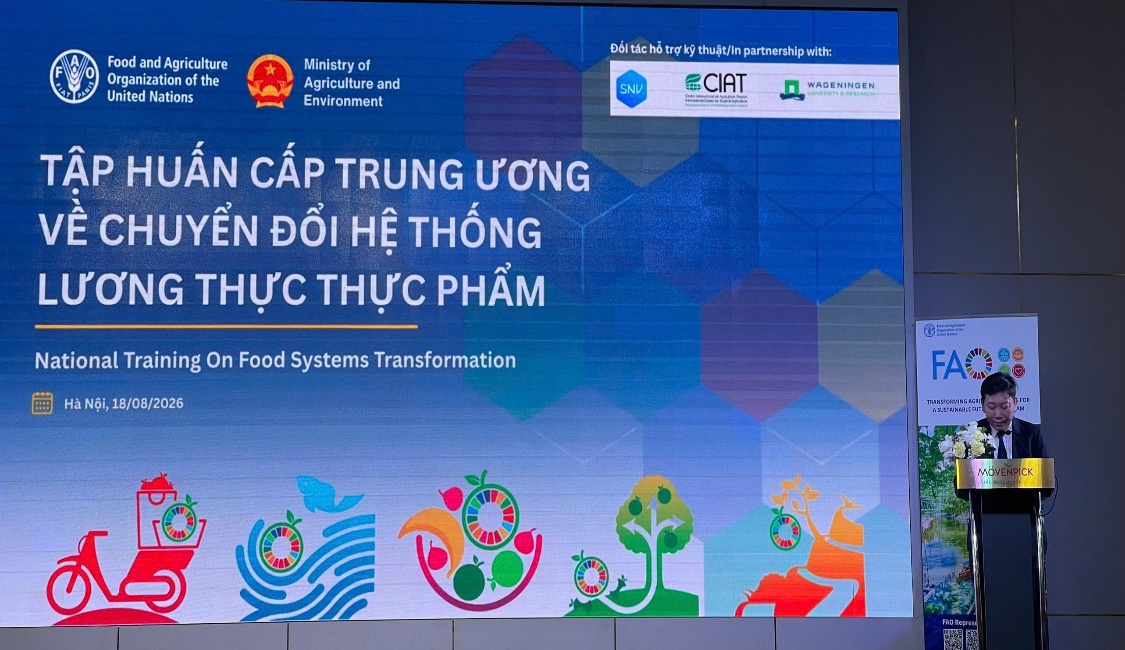
Mr. Nguyen Do Anh Tuan – Director General of the Department of International Cooperation, Ministry of Agriculture and Environment, delivering his opening remarks
Mr. Vinod Ahuja – FAO Representative in Vietnam highly appreciated Vietnam's pioneering position in food system transformation. He also noted that a policy designed to address one issue could simultaneously create other impacts in an area under the scope of another agency. This illustrates the complexity and interconnection of the food system, in which agriculture, health, environment, social welfare and many other sectors interact closely with one another. Therefore, policies and solutions also need to be developed on the basis of a whole-system view and the linkages among sectors.
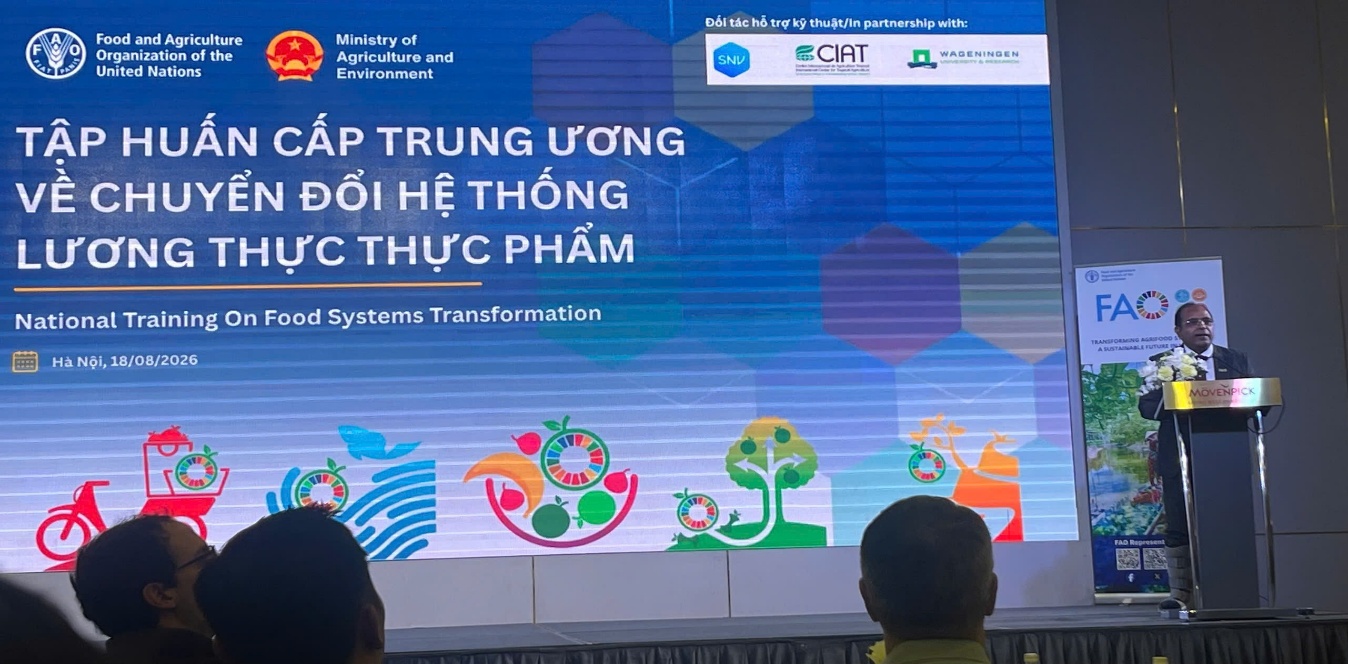
Mr. Vinod Ahuja – FAO Representative in Vietnam delivering his opening remarks
Mr. Mark Mason Lundy – Global Research Director, Food Environment and Consumer Behavior team, the Alliance of Bioversity International and CIAT, emphasized the need to strengthen practical capacity for action from the central level down to localities, communes/wards and households. In addition, stakeholders need to make efforts to reorient and optimize existing public-private funding flows in order to create substantive changes on the ground.
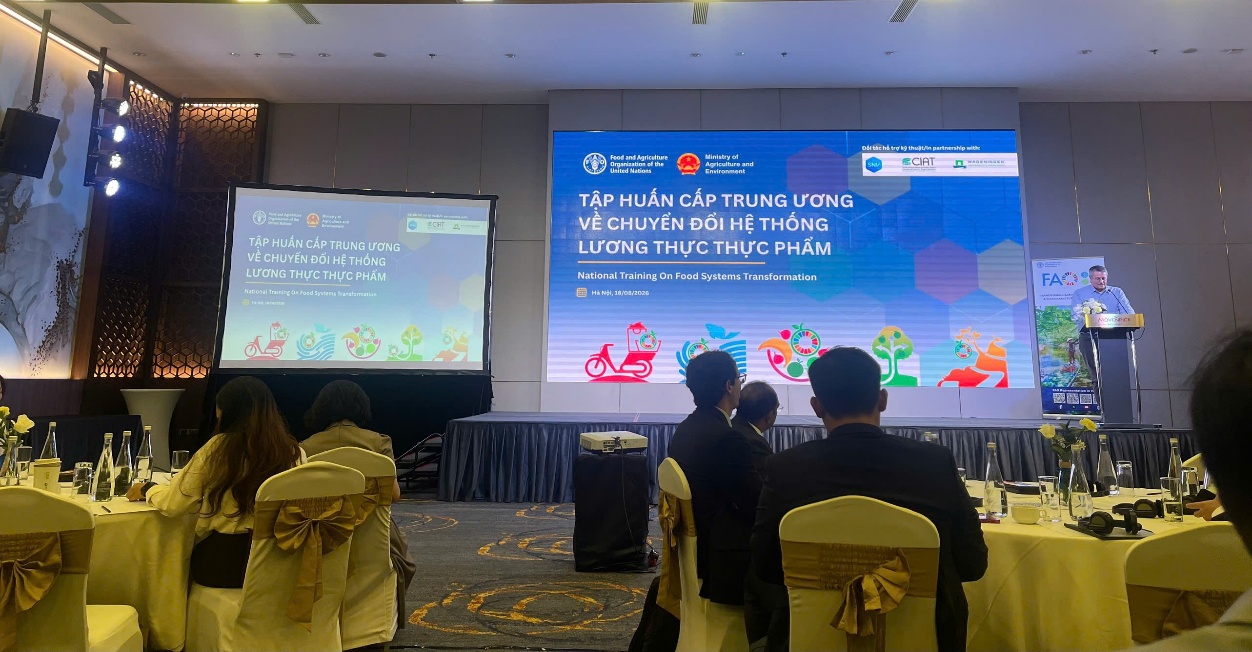
Mr. Mark Mason Lundy – Global Research Director, Food Environment and Consumer Behavior team, the Alliance of Bioversity International and CIAT, delivering his remarks
Following the opening session, the program continued with technical sessions focusing on clarifying the food system approach and gradually translating systems thinking into concrete methods, tools and actions for developing, coordinating and implementing the objectives and tasks set out under the National Action Plan on Food System Transformation pursuant to Decision No. 300/QĐ-TTg dated March 28, 2023.
At the start of the technical session, experts from FAO and Wageningen University introduced the key concepts and principles of food systems, while clarifying why a systems approach is needed rather than focusing on isolated interventions. The presentation focused on analyzing the features that make the food system complex, such as its multi-functionality, interlinkages, diversity and path dependency, thereby showing that the factors and decisions within the system can interact with one another and shape the outcomes of the policy-making and implementation process. The experts also clarified how policies and investment in one area can generate co-benefits and trade-offs but may also bring about certain unintended consequences in other areas. Therefore, identifying and managing trade-offs while strengthening synergies is an important factor in achieving multiple outcomes simultaneously and promoting sustainable food system transformation.
In the following topic, delegates were further provided with an overview analysis of Vietnam's food system, from production, processing and distribution to consumption; along with an introduction to the National Action Plan on Food System Transformation, activities that have been and are being implemented, the role of multi-stakeholder cooperation, as well as Vietnam's Food System Transformation Partnership (FST-P).
One topic shared by speakers at the training was strengthening the leading role of the public sector and inclusive stakeholder participation in the process of implementing food system transformation. Speakers argued that effective food system transformation needs to be supported by a shared vision, an appropriate governance mechanism, policy coherence and cross-sectoral coordination mechanisms. The public sector plays an enabling, coordinating role and creates a favorable environment; at the same time, substantive participation of the private sector, social organizations, research institutes, localities and communities needs to be mobilized in the process of developing and implementing policies. Policy coordination also needs to be carried out as a continuous cycle from design, integration and implementation to monitoring, learning and adjustment.
The program also devoted significant content to sharing the Monitoring and Evaluation Framework for the implementation of the action plan on food system transformation in Vietnam and learning based on a systems approach (Systems MEL). Developing the Monitoring and Evaluation Framework for the objectives of Decision 300/QĐ-TTg involves a number of different steps. The Monitoring and Evaluation Framework is a tool that helps track progress and outcomes in achieving the objectives, strengthens accountability for reporting, consolidates information, identifies areas requiring attention and supports the decision-making process. The draft Monitoring and Evaluation Framework comprises 32 indicators under 5 groups, covering general issues, agricultural inputs, production, distribution and processing, as well as consumption outcomes; of which 18 indicators are being integrated by the Ministry of Agriculture and Environment into the monitoring indicator system for the agriculture and environment sector.
Experience moving from vision to action, along with solutions and proposed priorities for integrating food system transformation into the policy-making process, was also shared with keen interest by experts, policymakers, officials at both central and local levels, and international organizations. A representative of the Department of Cooperative Economy and Rural Development presented experience on integrating a nutrition-sensitive food production development model into the Sustainable Poverty Reduction Program. From a local implementation perspective, a representative of the Son La Provincial Department of Agriculture and Environment shared the process of developing and implementing Son La Province's Plan No. 161/KH-UBND on food system transformation to 2030. The province has carried out activities to give concrete shape to the food system transformation objectives in a transparent, accountable and sustainable direction; strengthened coordination among departments and sectors; and integrated tasks into related programs and plans. Going forward, the province intends to continue closely following the objectives, tasks and solutions of Plan 161/KH-UBND, while allocating and integrating resources from the state budget, national target programs and socialized funding sources to promote system transformation actions and the development of agricultural value chains. A speaker from SNV shared nature-based solutions (NbS) as an important approach contributing to the implementation of the National Action Plan on Food System Transformation in a transparent, accountable and sustainable direction, while also analyzing the potential for applying NbS in implementing Decision No. 300/QĐ-TTg, particularly in developing ecological agriculture, sustainably managing land and water resources, promoting low-emission production and building resilient value chains.
Throughout the presentations and discussions, the common message emphasized was the need to shift from “vision” to “systems action”; from isolated actions to coordinated joint decision-making; from independent programs and projects to portfolios of mutually reinforcing and complementary actions and investments; and from monitoring mainly for reporting purposes to monitoring for learning, adaptation and timely adjustment. Tools such as system mapping, stakeholder mapping, policy mapping, trade-off and synergy analysis, action portfolio design, identification of financial resources, and monitoring, evaluation and learning systems can provide practical support for implementing the National Action Plan.
At the training workshop, delegates and experts were divided into groups to practice, discuss and carry out group exercises, thereby applying the knowledge, methods and tools introduced during the training to practical situations. Based on the priority areas of the National Action Plan on Food System Transformation, the groups jointly identified stakeholders, analyzed linkages, synergies and trade-offs, and on that basis developed plans and proposed actions and solutions suited to stakeholder participation. This practical activity helped delegates translate the knowledge gained from the training into orientations and solutions that can be applied in the process of developing, coordinating and implementing policies at both central and local levels.
Through the presentations, discussions and practical activities, the training helped strengthen shared awareness and enhance the capacity to apply systems thinking in planning, coordinating and implementing actions and policies. The outcomes of the program provide a basis for further promoting coordination among ministries, sectors, localities, research institutions, the private sector and development partners to jointly take action and contribute to the effective achievement of the objectives of the National Action Plan on transforming Vietnam's food system in a transparent, accountable and sustainable manner./
Some images from the technical sessions and group discussions