Participants attending the provincial-level ToT training in Dong Thap
In the context of growing challenges of the global food systems including climate change, the need to ensure food security, and changing consumer demands on quality, nutrition and sustainability, Viet Nam is promoting a new approach to transforming food systems towards greater transparency, responsibility and sustainability. The training course in Dong Thap aimed to strengthen the province’s capacity for food systems transformation, develop a core team of trainers, and enhance participants’ ability to apply a systems approach to review, update and implement local action plans. The 1.5 days in-person training was held on 24–25 August 2026 at Cuu Long Hotel in Dong Thap, bringing together nearly 50 representatives from provincial government agencies, research institutes, international organizations, universities and other relevant stakeholders.
Having a speech at the training, Mr. Le Chi Thien, deputy director of the Department of Agriculture and Environment of Dong Thap Province, emphasized that food systems transformation should be approached comprehensively, covering the entire chain from inputs, production, processing and distribution to consumption. For Dong Thap, priorities include improving the efficiency of production organization and value-chain linkages for key agricultural commodities, while ensuring food safety, enhancing economic efficiency, and using natural resources sustainably and protecting the environment. He also noted that, as markets place increasing emphasis on product quality and transparency, the province needs to further strengthen traceability and quality control, while enhancing the responsibilities of stakeholders throughout the food system.
Dr. Truong Thi Thu Trang, Vice Director General of the Institute of Strategy and Policy on Agriculture and Environment (ISPAE), emphasized that food systems transformation should be closely linked to agricultural restructuring, ecological agriculture development, and the localization of Decision No. 300/QD-TTg in line with local conditions. For Dong Thap, Plan No. 241/KH-UBND dated 6 July 2023 should be reviewed and updated to reflect the province’s new development space following the administrative merging process, while strengthening intersectoral coordination and mobilizing participation from non-state actors.
|
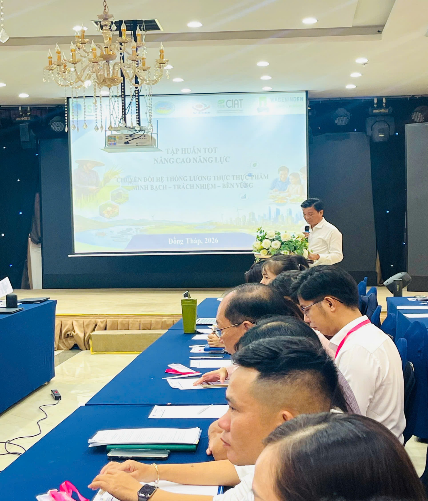
Mr. Le Chi Thien, Deputy Director of the Department of Agriculture and Environment of Dong Thap Province delivered the opening remarks
|
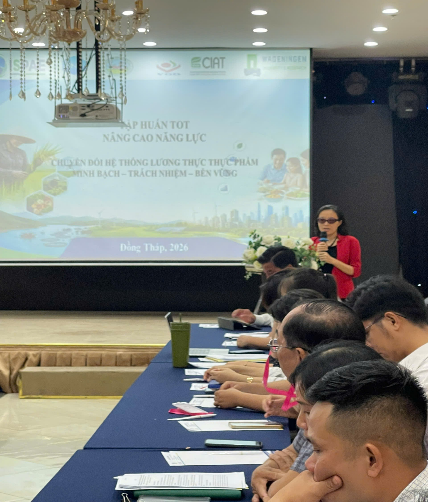
Ms. Truong Thi Thu Trang, Vice President of the Institute of Strategy and Policy on Agriculture and Environment (ISPAE) delivered the opening remarks
|
Ms. Bui My Binh, representative of the International Cooperation Department under the Ministry of Agriculture and Environment, emphasized that Viet Nam is shifting from a focus on productivity and output towards building food systems that are sustainable, nature-positive and responsible. This transformation needs to be tailored to the specific context of each locality, with priorities including nutrition, food diversity, reducing food loss and waste, promoting responsible consumption, and strengthening stakeholder linkages.
Mr. Mark Mason Lundy, Global Research Director of the Food Systems Environment and Consumer Behavior Group, CIAT, emphasized that food systems transformation is a long-term process requiring the engagement of multiple stakeholders. Policies need to be accompanied by financial resources, implementation capacity and effective coordination mechanisms. Provincial and commune levels are where transformation is actually implemented; therefore, strengthening local capacity and building collaborative networks are essential to sustaining action beyond the training.
|
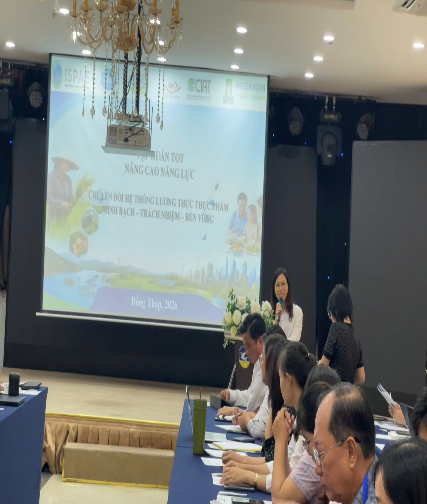
Ms. Bui My Binh, representative of the International Cooperation Department, Ministry of Agriculture and Environment, delivered the opening remarks
|
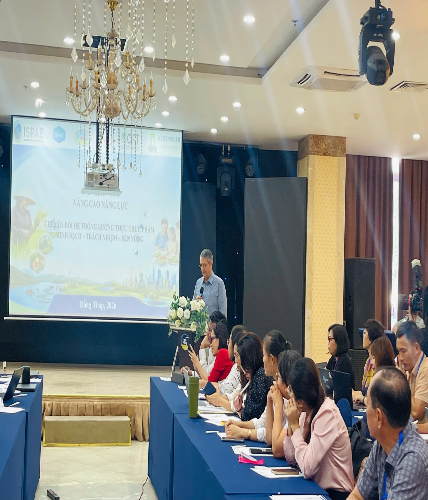
Mr. Mark Mason Lundy, Global Research Director of the Food Systems Environment and Consumer Behavior Group, CIAT delivered the opening remarks
|
At the training course, participants were equipped with knowledge and skills on food systems, their key components, and the systems approach, with a focus on applying these concepts directly to the context of Dong Thap Province. A key feature of the training was the “learning by doing” approach, through which participants not only acquired knowledge but also practiced the tools through group exercises based on real challenges and priorities in the province.
Through the practical exercises, participants progressively mapped the local food system; identified and analyzed stakeholders; assessed the current situation and priority issues; analyzed cause-and-effect relationships; identified leverage points; and proposed intervention solutions. This approach helped participants better understand the interconnected and cross-sectoral nature of food systems, while also generating initial outputs that can inform the development and implementation of local plans and programs.
A key focus of the ToT was the review and updating of Dong Thap’s Action Plan for Food Systems Transformation under Plan No. 241/KH-UBND dated 6 July 2023. Through practical group exercises, participants discussed and proposed priority objectives, intervention solutions and actions, lead and coordinating agencies, required resources, and potential models/projects for implementation. This process directly connected the knowledge and tools introduced during the training with the province’s practical needs, while providing an initial basis for further reviewing and adjusting Plan 241 in the new context.
The discussions and practical exercises also demonstrated that food systems transformation cannot be addressed from the perspective of a single sector, but requires intersectoral coordination and multi-stakeholder collaboration involving agriculture, health, industry and trade, science and technology, natural resources and environment, education, local authorities, businesses, cooperatives and other relevant organizations. Bringing together participants from different sectors created an important space for sharing experiences, building a common understanding and strengthening connections among stakeholders.
The outcomes of the training extend beyond strengthening the capacity of local officials. They also provide a foundation for continued review and updating of Plan 241/KH-UBND, linking existing programs, projects and resources, and promoting transformation initiatives aligned with Dong Thap’s local conditions and development priorities. The training also marks an important starting point for participants to continue sharing knowledge, providing technical support and promoting the systems approach across different levels, sectors and stakeholder groups for food systems transformation in the province./
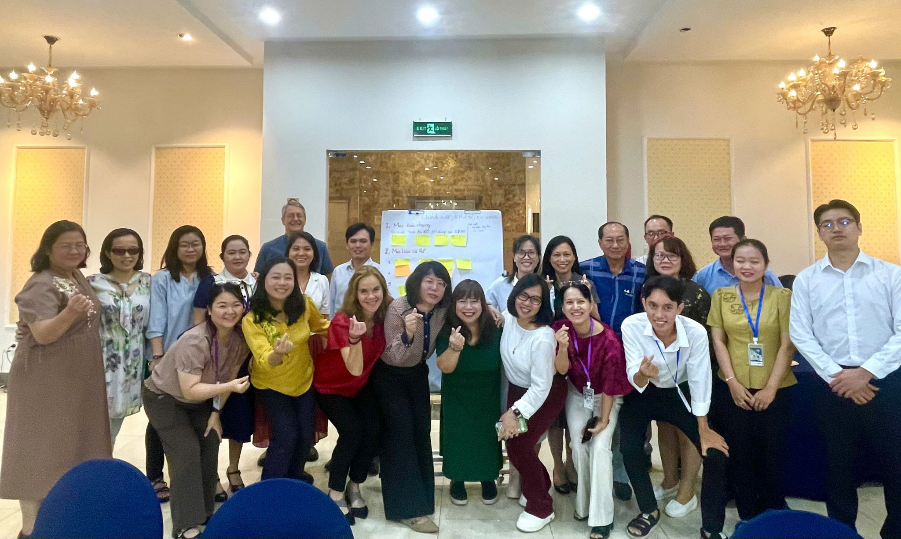
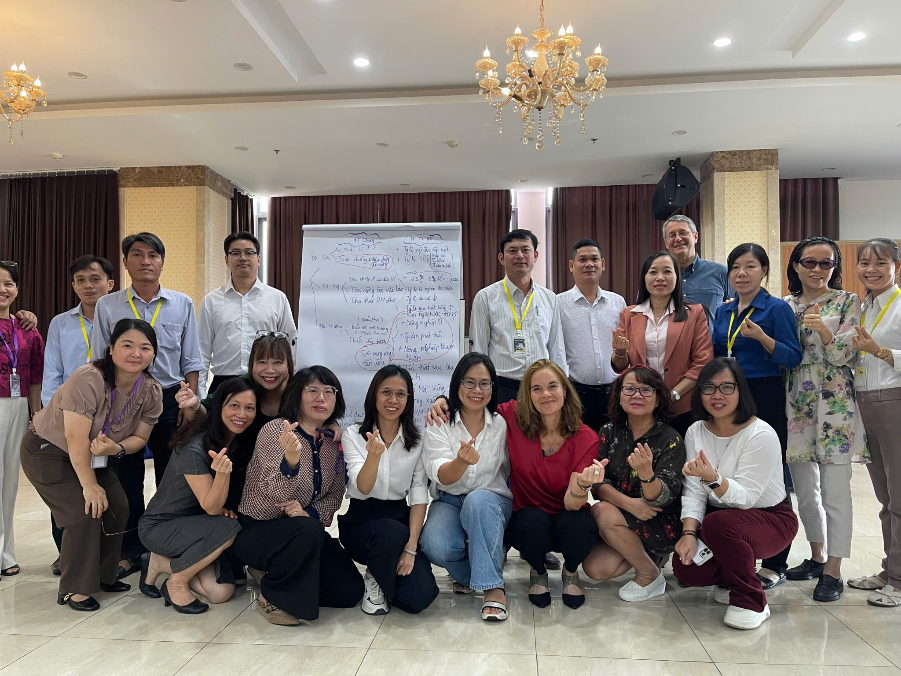
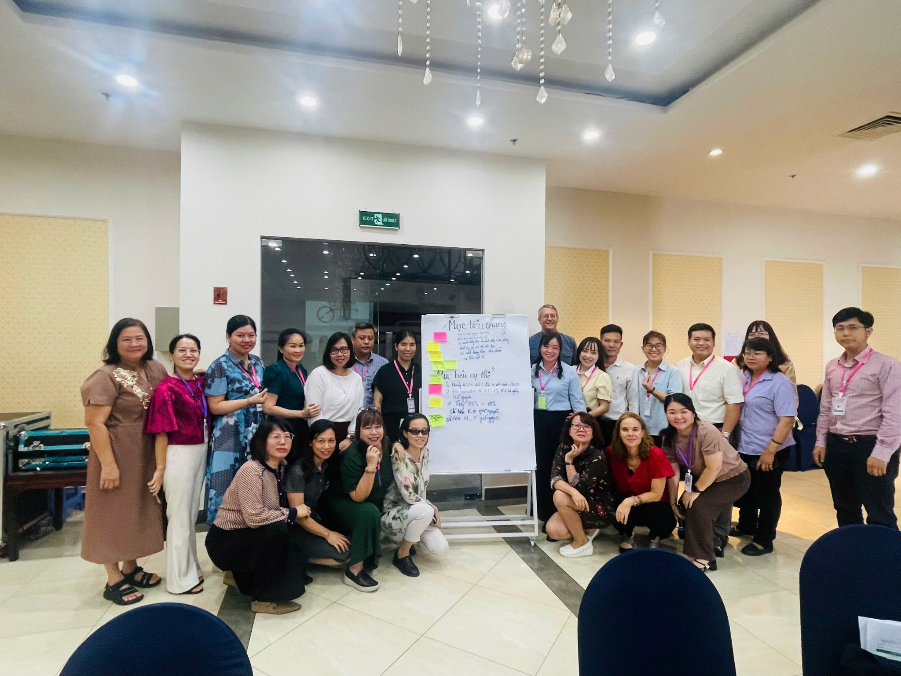
Source: CAP/ISPAE, 2026.